How the Free Press Killed Pol Pot
Excerpts from Sympathy for the Devil: A Journalist's Memoirs from Inside Pol Pot's Khmer Rouge.
(C) All rights reserved. No republication in whole or in part without express written permission from the author)
This week is the anniversary of both the rise to power and the death of one of the 20th centuries most egregious architects of crimes against humanity. On April 17 1975, Pol Pot's Khmer Rouge seized power and, during the following three years, eight months, and 20 days in power, oversaw the death of nearly 2 million people. On April 15, 1998, Pol Pot died in a besieged thatch hut in a malarial ridden jungle in the mountains of northern Cambodia. Here is a story from that day.
By Nate Thayer
April 18, 2018
When my mobile phone rang in the remote Thai hotel, I reached past the half-empty bottle of fake Johnny Walker Black whiskey, grabbed the remote on the bedside table to mute CNN blaring on the television, and answered.
"My friend, Pol Pot is dead!" said Khmer Rouge General Khem Nuon in an urgent whisper. "He died a few minutes ago at 10:15 tonight!"
I looked at the time on the TV screen. It was 10:32 PM _o_n April 15, 1998.
While the Khmer Rouge always whispered, they were rarely breathless. "What should I do?" he pleaded. "You must tell the Americans and you must come here immediately!"
Calling on a Chinese military radio phone from Khmer Rouge jungles, their top army field commanderwas desperate and looking for guidance.
I told him I would find my way to his jungles after dawn broke in the morning.
As we spoke, footage of Monica Lewinsky exiting a court house splashed across CNN.
I knew the story of attempts to topple the US president for an indiscreet blow job would continue to dwarf the news that one of the centuries most notorious despots had died without ever having faced justice.
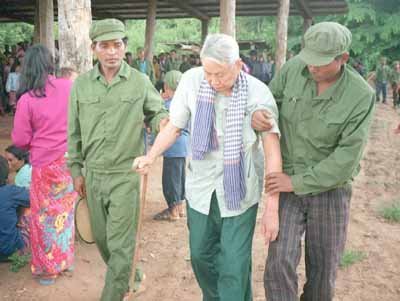
Moments later, a U.S intelligence officer called from Bangkok wanting to know if I had heard "rumors" that Pol Pot was dead. Nuon's phone was tapped as was mine and the American spook wasn't trying to fool either of us. It was a game whose rules I had learned years earlier.
But the American also knew that monitored phone conversations were insufficient to confirm such an historic event. They, as I, needed proof this wasn't some kind of political trick; someone independent and credible needed to go to the jungle and return with detailed evidence of what had happened.
Hard evidence was needed that Pol Pot was dead, that the body laying in the jungle was, in fact, Pol Pot, and, importantly, the cause of his death.
The American wanted me to bring Pol Pot's body back with me to Thailand. "If you can't do that, maybe you could cut off one of his fingers," he suggested seriously, in an only fleetingly embarrassed tone. "Or at least get a lock of his hair."
He needed to be able to tell Washington with certainty what had just happened in these jungles inaccessible to them. His crude suggestion didn't faze me at the time, at all. I told him I would do my best, and I meant it.
While the Khmer Rouge wanted me to come, and Gen. Nuon controlled the troops at his jungle checkpoints, crossing out of Thailand into Khmer Rouge territory required another set of permissions.
Neither the Thais or the Americans wanted to be seen as involved in what surely would soon grab world headlines and attract scores of journalists to the border area.
Both had political restraints and could not simply show up at Khmer Rouge field headquarters, but I didn't.
By the time of Pol Pot's death in 1998, no government wanted to be seen as having friendly, or any relations, with the Khmer Rouge.
But everyone knew I still maintained good contacts with the guerrillas, and as a journalist this was wholly legitimate. Beholden to no one, I could hold the mantle of an independent, neutral journalist around my neck, which I defended proudly and without compromise.
I asked the American spook to contact the Thai army commander-in-chief requesting direct permission for me to pass through the heavily guarded Thai military checkpoints and exit Thai national borders at dawn into Khmer Rouge controlled jungles.
A few moments after I hung up with the American spook, the top personal aide to the Thai army commander-in-chief called. He said the Thai army chief had personally granted me permission to clandestinely cross the land border from Thailand to the Cambodian forests where Pol Pot lay dead. He gave me the name and mobile phone number of the special forces Colonel who commanded a highly secret Thai military unit who I knew only by reputation. This Colonel had already been instructed to meet me at an inconspicuous gas station on a remote stretch of provincial road at dawn.
Officially, Regiment 16, based in a remote location along the border and charged with the extremely sensitive task of controlling access to and liaison with the Khmer Rouge, didn't exist and performed functions Thailand officially denied it engaged in.
The Thais had long denied they had direct dealings with the Khmer Rouge, loathed the periodic public fallout from revelations to the contrary, and were under intense international scrutiny and United Nations official directive to not assist them.
I had no political problems with associating with international pariahs and murderers. I rather enjoyed it. And for some reason they seemed to get along with me, too. Rogue people and nations have always fascinated me.
It started as my job. Then it became my obsession.
But the night of Pol Pot's death, in many ways, marked the end for me, too, when that chapter of my lifework was finally over.
It was after midnight now. Pol Pot was dead.
I felt numb mainly, but also relieved. My mind raced with the thousands of broken Cambodians I had met over the years who had, in many ways, been unfortunate enough to survive Pol Pot's reign in power.
While I drank more straight whiskey from a glass and re-organized my gear to cross the border in a few hours, I watched Monica Lewinsky play over and over on CNN, flashbulbs sparkling as she fled into a courthouse to face the full puissance of the American justice system.
The twisted reality did not elude me that the full weight and power of the United States government deployed to pursue American justice for the sordid Lewinsky saga was given far more formidable priority than that deemed appropriate for pursuit of a man responsible for genocide and crimes against humanity.
It was a fact that when Pol Pot died, 20 years after he left 1.7 million people dead during his 3 years, 8 months, and 20 days in power, he had never been charged anywhere in the world by any court with any crime.
Under international law and in the eyes of the properly organized community of civilized nations, Pol Pot was not a wanted man.
But I knew that within hours Pol Pot would be featured alongside Monica Lewinsky in news headlines and scores of journalists would descend on the Thai border.
I wanted to get in and out of the Cambodian jungle before the circus began.
POL POT'S FINAL RESTING PLACE
It was an ignominious end for Pol Pot.
A Khmer Rouge soldier led me one hundred meters through a winding dirt path. "Don't step off the path!" he ordered. "There are landmines everywhere."
The sickly-sweet stench of death filled the still air of the spartan hut where Pol Pot's body lay bloating in the humidity of the monsoon season. Heavy artillery explosions landed around us and exchanges of automatic-weapons fire echoed in the nearby jungle as exhausted Khmer Rouge guerrillas tried to hold off government troops advancing up the mountainside.
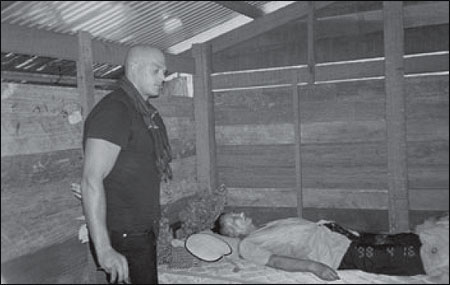
Eight hours had passed since Pol Pot's died, and his body was already decomposing in the tropical heat.
He had a pained expression on his face, as if he did not die peacefully.
One eye was shut and the other half open. Cotton balls stuffed in the orifices of his head failed to prevent leakage of body fluids. Swarms of flies, feasting on putrid smelling fluid leaking from his nose and mouth, landed on Pol Pot's vacant glazed eyeballs, their 1000 yard stare fixed on nothing. His face and fingers were covered with purple blotches. Wet yellow stains soaked his black pajama pants.
The incessant whirring sound of insects provided the sound track, punctured only by incoming mortar rounds and outgoing bursts of automatic weapons fire.
By his body lay the sum of his worldly possessions; his rattan fan, blue-and-red peasant scarf, bamboo cane, and white plastic sandals.
Two vases of freshly picked purple bougainvillea stood at the head of the bed. Otherwise, the room was empty, save for the Sony short-wave radio on his bedside table.
Outside the front door was a small vegetable garden tended by Pol Pot's wife and daughter; next to it, a freshly dug trench where Pol Pot and his family were forced to cower as artillery bombarded the jungle redoubt in recent days.
I was alone in the thatched roof hut on stilts, except for Pol Pot's wife, his 12-year old daughter, his most trusted political loyalist, and a single Khmer Rouge soldier armed with aChinese AK-47.
Perched nervously by his deathbed was Muon, Pol Pot's wife, a 40-year-old former ammunition porter. Pol Pot married her in 1985 after his first wife went insane after a Vietnamese military invasion ended the Khmer Rouge reign of terror. Clutching her hand was their 12-year-old daughter, Mul.
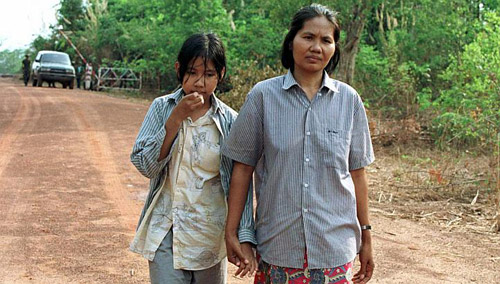
Muon seemed oblivious to her husband's bloodstained past, caught only in the anguish of the present. A peasant woman, Muon says she had never laid eyes on a Westerner before.
"He told me a few weeks ago 'My father died at 73. I am 73 now. My time is near,'" she said "It was a way of telling me that he was preparing to die."
Reaching down to caress his face, she burst into tears. "He was always a good husband. He tried his best to educate the children not to be traitors. Since I married him in 1985, I never saw him do a bad thing."
Asked about his reputation as a mass-murderer, her lips quivered and she cast a terrified glance at the senior Khmer Rouge cadre hovering nearby. "I know nothing about politics," she said. "It is up to history to judge. That is all I want to say."
She had good reason to be terrified.
Moments before, I had sat with Khmer Rouge overall leader Ta Mok, the one-legged guerrilla commander not so affectionately known as 'The Butcher.' "As to what I will do with his family, I haven't decided. If I let them go, will they say anything bad about me? Maybe they might be used by Hun Sen," he said, referring to his nemesis, the Cambodian premier.
"Pol Pot died of heart failure," Ta Mok said. "I did not kill him."
Pol Pot's wife corroborated Ta Mok's account of her husband's death. "Last night, he said he felt dizzy. I asked him to lie down. I heard him make a noise. When I went to touch him, he had died."
Asked how she wanted her father remembered, Pol Pot's only child stood with her head bowed and her eyes filled with tears. One hand covered her eyes and the other tightly gripped that of her mother. "Now my daughter is not able to say anything," interjects Muon. "I think she will let history judge her father."
History will have to, because death had deprived the world of the chance to judge the man responsible for the deaths of nearly 2 million people.
Outside Pol Pot's final resting place, surrounded by a mine field, chaos reigned.
Khmer Rouge leaders insisted to me that Pol Pot, aged 73, died of natural causes. Already visibly ill and professing to be near death when I interviewed him the previous October, he was further weakened by a shortage of food and the strain of being moved around to escape the government offensive.
Fear was etched in the faces of many leaders and cadres–and for good reason.
Khmer Rouge cadres and Pol Pot's wife recounted the last, ignominious days of his life, as he was moved through the jungle to escape advancing troops.
The previous night, Mok wanted to move Pol Pot to another house for security reasons. "He was sitting in his chair waiting for the car to come. But he felt tired. Pol Pot's wife asked him to take a rest. He lay down in his bed. His wife heard a gasp of air. It was the sound of dying. When she touched him he had passed away already. It was at 10:15 last night," he told me.
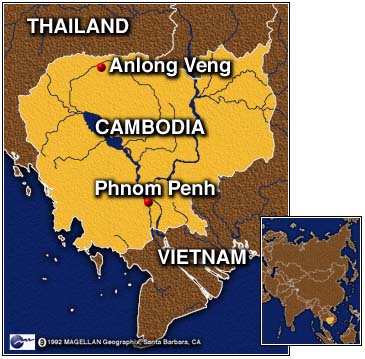
Pol Pot's last days were spent in flight and fear of capture–a humiliating end for the man who ruled Cambodia from 1975 to 1979. According to his wife and Khmer Rouge leaders, he dyed his hair black in a desperate attempt to avoid capture by mutinying Khmer Rouge troops as he fled up the Dongrek mountain escarpment north of Anlong Veng. "Pol Pot feared that he could be caught. By dying his hair he was trying to disguise himself. For such a person to do that, it showed real fear in his mind," said Gen. Non Nou, who was assigned as Pol Pot's personal jailer and security guard and was in charge of escorting Pol Pot to safety during those days.
The guerrillas had been unable to provide their ousted leader with sufficient food since being forced from their headquarters in late March. "For the last few weeks he had diarrhea and we haven't had much food because of the fighting with the traitors," recounted Ta Mok.
As Pol Pot fled up the side of the malarialinfested mountain, the remnants of the movement he created 38 years before were crumbling before his eyes. A few days before his death, he was being driven with his wife and daughter to a new hideout by Gen. Non Nou, his personal guard. From his blue Toyota Land Cruiser, Pol Pot saw more than 30,000 Khmer Rouge civilians without food or shelter, exhausted, sick, and laying in the mud after having been forced from their already meager thatch roofed huts, fields, and villages from fighting against government troops and Khmer Rouge defectors.
"When he saw the peasants and our cadre lying by the side of the road with no food and water or shelter, he broke down into tears," said Non Nou.
His wife echoed the account, and said her husband turned to her in the car and said: " My only wish now is that Cambodias stay united so that Vietnam will not swallow our country."
After days of fleeing through the jungle, Pol Pot was weak and despondent. In flight and fearing capture, it was the beginning of a humiliating end for the man who ruled Cambodia from 1975 to 1979.
Mok's brutal tactics were also a source of unease among the remaining Khmer Rouge loyalists. "Our movement will only get stronger. We have sent our forces close to Phnom Penh and they have carried out their tasks successfully," Mok told me that day while we sat in a crude ammunition depot less than 50 meters from where Pol Pot lay dead. The "task" he boasted of was the recent massacre of 22 ethnic Vietnamese civilians, including women and children, in a fishing village in Kompong Chhnang province.
"There may be more traitors, it is normal. But in the end they will all die," Ta Mok said.
He was a man of his word. Three top military commanders arrested with Pol Pot nine months earlier had just been retrieved from their underground bamboo prison cages and executed because some of the fighters who mutinied were loyal to them. "It was a decision made by the people," Ta Mok shrugged.
Ta Mok's growing paranoia and isolation were evident during my visit to their shrinking territory north of Anlong Veng the day after Pol Pot's death. Mok gave the impression of a man rapidly spiraling out of touch with reality, seeing enemies everywhere, seething with anger, and unwilling to compromise.
He vowed to fight on, and blamed his longtime comrade-in-arms for the Khmer Rouge's desperate plight. "It is good that Pol Pot is dead! I feel no sorrow," he said. Then he leveled a bizarre accusation against the rabidly nationalistic mass murderer: "Pol Pot was a Vietnamese agent! I have the documents!
Besieged in dense jungles along the Thai border, the remnants of the Khmer Rouge were battling for survival in the wake of three weeks of chaotic defections and the loss of their northern stronghold of Anlong Veng. Having lost faith in the harsh leadership of Ta Mok, several commanders were negotiating to defect.
A young Khmer Rouge cadre leaned close to me and whispered in Khmer: "This movement is finished. Can you get me to America?"
The fear and anger was thick, combining to threaten to send many of those making their last stand over the edge towards insanity.
"It is all because of the fucking anteaters!" cursed one Khmer Rouge soldier as he fired a burst from his AK-47 into the jungle. "The fucking anteaters!," he repeated, referring to a decision of his leaders to ban guerrillas from trading jungle wildlife with Thai villagers in exchange for food, batteries, salt, and cooking oil. This ignitedsimmering resentment and more defections—their leaders unable to provide salaries or provisions to the grunts on the battlefield.
The outburst did not merit more than a silent sideways glance from Ta Mok and other senior cadre towards the soldier ten meters away crouched facing the dense forest firing an automatic weapon and talking to himself.
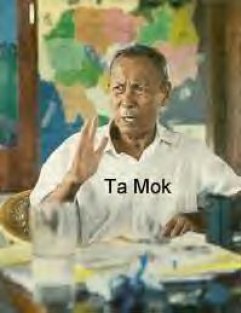
Ta Mok knew that his own capture and trial was sought by the international community. He wanted to use Pol Pot's death to wipe the slate clean. "The world community should stop talking about this now that Pol Pot is dead. It was all Pol Pot. He annihilated many good cadres and destroyed our movement. I hope he suffers after death," he says.
He then asks a visiting reporter to get hold of a satellite telephone for him, sketching a collapsible phone he had seen. "I want a good telephone. One that I can call anywhere in the world!"
But working the phone would not prevent Mok from rapidly losing the loyalty of even more of his own last loyalist commanders. Privately, many of his top officers and cadres held him responsible for the collapse of the movement he had seized control of from Pol Pot the previous July.
"He is very tired," said a senior Khmer Rouge official. "No man can shoulder all the political, diplomatic and military burdens by himself."
Others were less kind. "He has no more support from many of his own people," whispered one cadre. "But we don't know where to go. Cambodia has no good leaders."
WHO KILLED POL POT?
There was no visible evidence that the former Cambodian dictator was murdered that day. Cadres had insisted he had died of a heart attack. But I was to soon find out that was not true.
Several days before Pol Pot died, I received an urgent phone call at my home in Bangkok from General Nuon in the jungle. He said I "must come to meet us immediately."
Weeks earlier, at the request of the Khmer Rouge, I had relayed the request that the guerrillas wanted to meet with American intelligence officials to discuss turning over Pol Pot to face a properly organized court for his crimes while in power.
Two embassy officials from Bangkok travelled to the Thai border province of Surin and checked into an obscure Chinese hotel, where they met General Nuon and another Khmer Rouge official who told them that they had decided to turn Pol Pot over. "The Americans said 'we will get back to you. We have to send this information to Washington for an answer'," General Nuon told me. "But they never got back in touch with us!" said a genuinely perplexed Nuon.
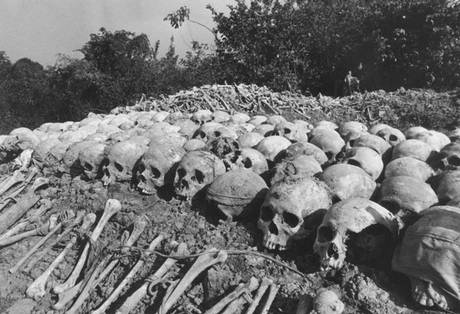
On March 25, fearing Pol Pot would be captured after fighting broke out and the Khmer Rouge headquarters at Along Veng fell to government forces, Pol Pot was secretly moved to a safer sanctuary in Thailand. Pol Pot was being held at a remote Thai military base in the Thai border province of Sisaket, the headquarters of regiment 16, a highly sensitive Thai military unit that technically did not exist and was long charged with handling secret interactions with the top Khmer Rouge leadership.
It was a stunning development. For the first time since he orchestrated the genocide that left millions of lives in ruin and after twenty years on the run as one of the worlds most wanted and notorious fugitives, Pol Pot was in custody of another government, outside of Cambodia, and the decision had been made by his last protectors and loyalists to turn him over to an international court to face justice.
But what followed was an extraordinary series of American bumbling that allowed one of the centuries most notorious despots to cheat justice.
The Americans never got back in touch with the Khmer Rouge. And the Thais, nervous that it would be leaked that one of the world's most notorious despots was in their custody on Thai territory, returned Pol Pot to the Khmer Rouge who moved him back to the other side of the border onto Cambodian territory.
Pol Pot never would have fathomed that the hated Americans, now the worlds only superpower, who had been chasing him for 30 years and had fought a five year war to destroy him before he took state power in 1975, would be so unorganized that they would be unable or unwilling to seize him and take him into custody.
Still unaware that Pol Pot was being held in Thailand, in early April I got an urgent call from General Nuon saying he needed to see me immediately in Surin. "I have something important to discuss with you, my friend." Nuon never uttered my name on the phone, He began every conversation with "Hello, my friend."….
Nuon betrayed no specifics of why they needed to see me, only that it was urgent. The Khmer Rouge army-chief-of-staff and top field commander for Ta Mok said only "What you have been asking for we have agreed to."
I took that to mean that I had been granted another interview with Pol Pot, but I was to learn I was wrong. It was even more significant. The Khmer Rouge had decided, as I had been pressing them for months, to turn Pol Pot over to the international community to face a trial.
I was summoned to discuss the logistics of handing Pol Pot over to face justice. It was a desparateattempt to play their last card—to garner international support and stem mutinies which had metastasized into all out warfare now raging in their jungles threatening the collapse of their movement for the final time.
"We have decided to turn Pol Pot over to the Americans. But we can't get in touch with the Americans. We discussed it again this morning and Ta Mok agreed. So we want to give him to you," said the guerrilla commander.
I was, to put it mildly, momentarily flummoxed.
What the fuck was I supposed to do with Pol Pot? Put him in the back of the pickup truck and take him to the Far Eastern Economic Review office in Bangkok?
This was not part of my job description. I suggested promptly getting in touch with the International Committee of the Red Cross and gave General Nuon the appropriate contact details. "That is a very good idea!" Khem Nuon responded.
I had spent several days along the Thai-Cambodian rebel held border discussing their plight and interviewing their top cadre.
On the day Pol Pot died, I had filed a story with my magazine, the Far Eastern Economic Review, on the Khmer Rouge decision to hand over Pol Pot. The Review went to press at 6:00 pm Hong Kong time on Wednesdays, this being that day, April 15, 1998.
There were other details, but I knew that the decision to turn over one of the century's most egregious perpetrators of crimes against humanity to face justice was a very good story indeed.
The magazine released the highlights of the story in a press release that night, April 15, 1998, at 5:00 pm Bangkok time, 6:00 pm Hong Kong time. It was picked up immediately by the international wire services, shooting high up in their top world stories.
My story was broadcast by the Voice Of America at 8:00 pm Cambodian time on their Khmer language service, which Pol Pot had told me he listened to every evening.
I wrote that the Khmer Rouge had decided to turn over Pol Pot over to face an international court for his crimes. It ran on Voice of America Khmer language service radio at 8:00 o'clock Cambodia time that night. Pol Pot was listening, and two hours and 15 minutes later he was dead.
Pol Pot listened religiously to Voice of America broadcasts on that radio, but the April 15 news on the Khmer-language service may have been too much to bear. The lead story was my report in the Far Eastern Economic Review that Khmer Rouge leaders–desperate for food, medicine and international support–had decided to turn him over to face an international tribunal for trial for crimes against humanity.
"He listened to VOA every night, and VOA on Wednesday reported your story at 8 p.m. that he would be turned over to an international court," said Gen. Khem Nuon, the Khmer Rouge army chief-of-staff. "We thought the shock of him hearing this on VOA might have killed him."
In fact, Pol Pot had committed suicide. After listening to the radio report, Pol Pot summoned his wife and repeated "My father died when he was 73. I am 73 now. My time has come." He asked her to find medicine which he could take to kill himself. Muon ventured out into the night and returned with one full bottle of Valium and a bottle of Chloroquine—an anti-malarial medicine. It was the best she could find in these remote jungles with no villages of markets.
Pol Pot swallowed both bottles.
At 10:15 on April 15, 1998, his wife summoned the Khmer Rouge armed guard outside their hut to inform him Pol Pot had died.
It was not the resources, influence, or multi-billion dollar budgets of the world community who made Pol Pot face justice.
It was the Free Press that brought Pol Pot to justice.
The Far Eastern Economic Review was a full-service news organization. We tried him, we interrogated him, and then we killed him.
Which is far more than can be said for the many governments who failed to do their jobs in the decades after the Khmer Rouge leader used mass torture, crimes against humanity, and war crimes to effect genocide against his own people. ■
1 Reader Comment
bernd neidenberger says
(2018-10-31T13:51:05-05:00)
how can i mail with Chris Buckley,who wants to leave the KKK?
i am german,seeking knowledge about jewish witchcraft,coz i am ill.
thank you!