How Hordes of U.S. Republican Party Apparatchiks Toppled the Mongolian Descendants of Genghis Khan
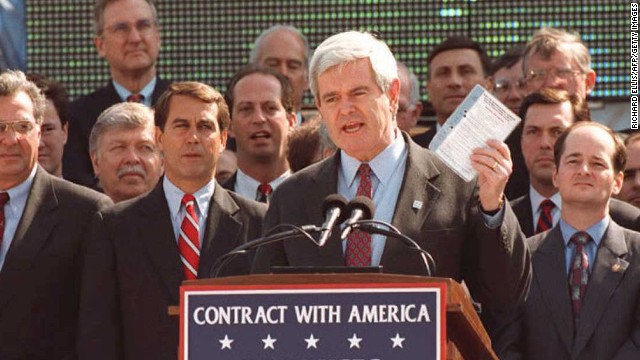
Newt Gingrich's "Contract with the Mongolian Voter" was the largest, most widely printed and distributed document in Mongolian History, and crucial to overthrowing the second longest ruling communist government without shedding a drop of blood.
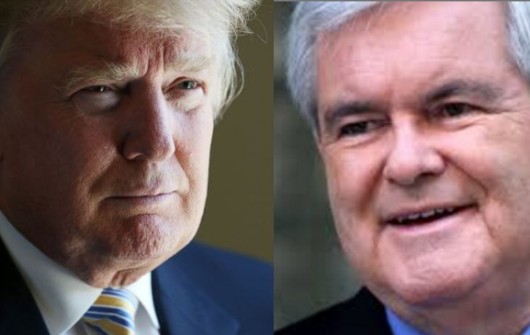
If one walks into Newt Gingrich's office, you will find a framed article I wrote for the Washington Post while reporting in Mongolia. Gingrich, who is a leading favorite as Vice Presidential choice of Donald Trump, has trumpeted his role in overthrowing the 2cd longest ruling Communist Party in the world.
From a 1997 New York Times Maureen Dowd column headlined "Genghis Newt":
_"Surely it was the first time this sentence had been spoken by a Congressional aide. "Excuse me, I have to go retrieve his Mongolian hat," Christina Martin, Newt Gingrich's press secretary, told reporters as the Speaker finished talking to conservative supporters on Monday night. The burgundy velvet and g_old crown-shaped hat sat on the podium at the Ritz Carlton Hotel, glowing serenely, the latest wacky Newt prop…
With his hat perched on the podium, he read part of a Washington Post story about how a G.O.P.-style revolutionary movement helped end Communist rule in Mongolia: "On a stool in his portable felt and canvas yurt, Yadamsuren, a 70-year-old nomadic sheep herder, offered a visitor chunks of sheep fat and shots of fermented mare's milk to ward off the unspeakable cold. . . . he spoke glowingly of the work of House Speaker Newt Gingrich and the Republican Party. 'I read the Contract With the Voters closely,' he said."
The Speaker of the Yurt beamed: "Isn't it exciting to know that not only in America but in Mongolia ideas are working?"
His aides passed out a paper that read: "Why Republicans Should Be Confident — A Message from Speaker Newt Gingrich. When even The Washington Post reports that House Republicans have helped liberate the people of Mongolia, we are winning. Read the attached articles (and note that the Mongolian Contract had 350,000 copies printed in the widest distribution in Mongolian history, including by camel and horse)."
Afterward, critics tittered. "In two years," said Bill Kristol, editor of The Weekly Standard, "we've come from the Contract with America to the Contract with Mongolia."
" 'Our ideas are taking hold in Mongolia' — it sounded like a 'Saturday Night Live' routine," said Arianna Huffington."
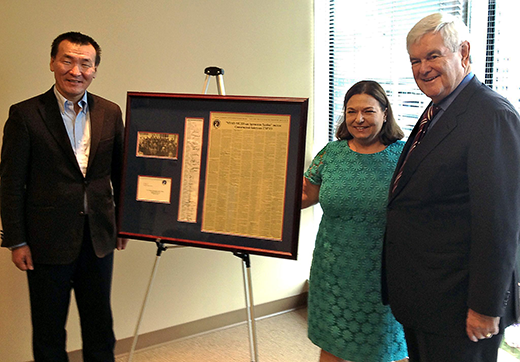
The "Contract with Mongolia."
IN MONGOLIA, A GOP-STYLE REVOLUTIONARY MOVEMENT
By Nate Thayer
Ulaanbaatar, Mongolia
The Washington Post
April 6, 1997
On a stool in his portable felt and canvas yurt, Yadamsuren, a 70-year-old nomadic sheepherder, offered a visitor chunks of sheep fat and shots of fermented mare's milk to ward off the unspeakable cold.
Seventy miles of bleak desert northeast of Ulan Bator and many miles from the nearest neighbor, he spoke glowingly of the work of then U.S. House Speaker Newt Gingrich (R-Ga.) and the Republican Party. "I read the `Contract With the Voter' closely. Everybody did," he said, explaining why he decided to vote for a new government in Mongolian elections last June. "In the contract, they clearly say what society and the people can do for each other."
American hordes, led by the Republican Party, have invaded the steppes of Mongolia in recent years. Instead of calvaries, they have comprised teams of election strategists and campaign organizers, who mobilized a once ragtag Mongolian opposition to achieve victory in national elections last June 30.
In what was once an impenetrable Soviet satellite, a remarkably young democratic government has taken power, creating Asia's first successful transition from communism to democracy.
A key element behind the victory, say Mongolia's new leaders, was a carefully engineered strategy by American Republican political operatives to end 75 years of Communist Party control. And the tool that the Mongolian Democratic Union credits for victory was none other than the "Contract With America," the platform used in 1994 by revitalized Republicans to sweep into control of the U.S. Congress.
"This form of signing a contract with the people is a new achievement of the Mongolian political system, even of political science," said Prime Minister M. Enkhsaikhan in a recent interview, smiling in his drab Soviet-built office in the main government square in Ulan Bator.
But today the halls of government in Ulan Bator could be mistaken for a university campus. Of the 50 new Democratic Union coalition legislators who gained power in the elections, 36 are in their twenties or thirties; the prime minister is 41, the parliament speaker is 43, and the minister of defense is 38. "It is an unqualified success of political transformation," said a Western diplomat here. "But the 50 Democratic Union MP's and new government have virtually no previous political experience. The phrase `complete chaos' has been used."
When the Russians built a capital for their first satellite country, populated by nomadic herdsmen, they named it Ulan Bator, which means "red hero" in Mongolian.
But the winds of political change have swept again across this isolated but strategically important corner of northeast Asia. Mongolia's new freewheeling democracy has scores of newspapers, dozens of political parties and vigorous debate within the government, achieved without bloodshed or resistance from the Mongolian People's Revolutionary Party, the once-Stalinist Communist Party in uninterrupted power since 1921. Under the pressure of demonstrations in 1990, the government promised political and economic reforms, and the first multi-party parliamentary elections were held in 1992. The disorganized opposition only garnered six seats, leaving the other 70 — and the government — firmly in the hands of the Revolutionary Party.
In the wake of the crushing defeat, the Mongolian opposition began to work together with Republican advisers to transform itself into a unified force with formidable campaigning skills. Such peaceful transformation stands in stark contrast to the turmoil that has beset Russia and many former Soviet satellites after the collapse of communism.
"For decades Mongolia was under the domination of foreign countries," Prime Minister Enkhsaikhan said in an interview with the Post . "So really Mongolia itself is a new nation."
The U.S. Republican Party help to the fledgling Mongolian democratic opposition began in late 1991. "It was a personal request from Secretary of State {James} Baker. He called us up when he returned from {an official visit to} Ulan Bator and said, `I think you need to do something there to help the democratization process,` " said Kirsten Edmondson, the Washington-based International Republican Institute (IRI) program manager for Mongolia. IRI — the Republican wing of the congressionally funded National Endowment for Democracy — dispatched staff members to Mongolia. They convinced squabbling groups of opposition forces — political parties, students, activists, nongovernmental organizations, intellectuals and businessmen — to form a united coalition.
IRI then trained candidates and supporters from the newly created National Democratic Union in the science of targeting voters with relevant messages, grass-roots party development and membership recruitment.
As the campaign season began in late 1995, Gingrich sent the authors of the "Contract With America" to Ulan Bator. Working with the Democratic Union, they drafted the "Contract With the Mongolian Voter."
Even the new Mongolian election law was lifted verbatim from the election law manual of Texas, Mongolian and IRI officials said.
The Contract with the Mongolian Voter called for private property rights, a free press and the encouragement of foreign investment.
It became the most widely distributed document in Mongolian history, according to Mongolian officials, with 350,000 copies printed in 1996.
The Americans convinced the opposition candidates of the importance of hitting the campaign trail — a concept previously unheard of here — personally taking their message to the far-flung corners of this country of 2.5 million people just under the size of Alaska.
And it was voters such as Yadamsuren, who like many Mongolians uses only one name, who put the new government in power. A herder like more than half of Mongolia's population, he owns 50 cows and sheep, which grazed nearby in minus 22 degrees Fahrenheit weather.
While his wife melted snow on a coal stove for drinking water for the livestock, he talked of giving the young opposition forces a chance to change Mongolia: "People understood that this new government wanted to put Mongolia on the same footing with other countries. We decided to give them the power to do it."
And it was the contract that persuaded him to vote out the Communists, he said. "We knew before the elections there were promises in the contract that could not be fulfilled, like raising the pensions. But in general, in a strategic sense, {the new leaders} are doing important things. We decided to give the younger generation a chance."
In dozens of interviews with ordinary Mongolians during a one-month trip through the country, all were familiar with the "Contract with the Mongolian Voter" and every Mongolian nomad living in the vast desert country in their portable tent-like traditional dwelling, known as a Ger, in this 15th largest nation on earth that straddles China and the former Soviet Union, knew who Newt Gingrich was.
On June 30, 1996, dressed in their finest traditional clothing, and traveling by horse, camel and on foot, 91 percent of the Mongolian electorate turned out to vote — -the biggest turnout by far in Mongolian history. The result stunned everyone, including the victors. Baker was on hand to witness the victory, having returned as a private citizen to serve as an official election monitor.
Diplomats and Mongolian officials agree that the Communists grossly miscalculated voter sentiment and the opposition's organization. All 50 of the newly elected legislators were trained by IRI, according to government leaders. IRI and Mongolian officials said the Communist candidates were offered training and assistance in campaign strategy by the Americans, but turned it down.
But diplomats and Mongolian officials are quick to credit the Communists for the smooth transition. "In many ways they are the unsung heroes. They had the army and the power. They could have just refused to turn it over," said an American diplomat.
In a July letter, two former leaders of the democratic opposition who suddenly found themselves head of parliament and the majority leader praised IRI and "all of our friends in America": "The victory of democracy in Mongolia demonstrates that the values of life, liberty, freedom of speech and respect for human rights and justice are not just American values, but universal values inherent in all people's, including the people of Asia," they said. "We want to thank our American friends who worked so hard to make this possible. The International Republican Institute stood side by side with us."
 ■
■
1 Reader Comment
Sos Kem says
(2016-07-04T20:49:40-05:00)
Nate is a good old friend. We have known each other since early 80s when he was a young boy fond of action and interested in true story supported by facts. Sos