Comrades in Mass Murder: The Secret Alliance Between Suicide Religious Cult Leader Jim Jones and North Korea
By Nate Thayer
June 17, 2014
During the final months prior to the November 1978 mass murder of 903 people in the jungles at the People's Temple at Jonestown, Guyana, the Utopian socialist experiment run by political/religious cult leader Jim Jones, Jones conducted ideological training classes where attendance was mandatory.
These ideological lectures, were led by an increasingly delusional and paranoid Jones-who by mid-1978 was incapacitated by psychosis, growing political and legal pressure from enemies in the United States, and a series of addictions to drugs, including methamphetamine.
This period coincided with a rapidly developing relationship with the government and agents of North Korea.
By early 1978, both Jones and North Korea had cultivated a close relationship and deep support for each other, had numerous clandestine meetings, and Jones escalated a constant rhetorical focus praising the country, the North Korean government and, particularly its leader, Kim Il Sung.
A March 17, 1978 document written to Jones by his top loyalist was a summary of a meeting held with the North Koreans at their embassy in Guyana:
"We were speaking to the first secretary when the Korean Ambassador entered to speak to us. He said they have been trying to locate us, they will have many things to do with us. He was glad to see us there as they were searching for our location. The First Secretary later told us they had heard of us in North Korea…He asked a lot of questions; basically he wanted to know the nationalities of our members, the names of the people who coordinate here and in the United States. E.g.…..Leaders proper names, how many Koreans, blacks, whites, Chinese, American Indians? Leaders children's names here and in the U.S., asked several times about (Jim Jones's adopted Korean son) Lew, said they would like to see him if he comes into town. He asked for directions to our home offices in Georgetown, said he would like to come. Sharon asked what they found interesting about us? He said they liked our involvement in humanitarian projects, and after reading and making the contact with us, it will make them more knowledgeable as to how we can cooperate and work together with them. He said they were interested in all progressive people. Sharon asked if he found it strange that a group of Americans were in Guyana living cooperatively? He agreed that they did. The Ambassador sent messages to us that he regretted he was not able to spend more time with us today, but he would see us another day. They gave us quite a bit of literature on Korea, and books written by their leader, comrade Kim Il Sung."
The pro Pyongyang rhetoric for the DPRK and Kim IL Sung escalated and increased in frequency until the immediate days before the mass murder/suicide on November 18, 1978.
More than a dozen countries were contacted after 1977 by letter, and at least five embassies in the Guyanese capital, Georgetown, were contacted directly as Jones sought support for a mass migration of the Jonestown People's Temple to a country perceived as more reliably loyal than what Jones felt was an increasingly unsure haven of Guyana.
Those embassies included, the Soviet Union, Cuba, Yugoslavia, and North Korea.
But Jones relationship with North Korea was the most fascinating and included genuine mutual affection between the two nations and their leadership.
Uniquely, North Korea was the sole country to have initiated contact with the People's Temple.
In fact, Pyongyang had, prior to 1977, praised the People's Temple over their state media. The North Korean leadership cabled their embassy in Guyana with instructions to locate and initiate contact with Jones' and his followers prior to Jones ordering his top lieutenants to contact the Pyongyang embassy in Georgetown, Guyana.
To the great interest and focus of North Korean agents, Jones and his wife had adopted three Korean war orphans in the 1950's.
The couple adopted three children of Korean-American ancestry: Lew, Suzanne and Stephanie. Jones had been encouraging Temple members to adopt orphans from war ravaged Korea. Since the 1950's as a preacher in Indiana, Jones had been critical of the United States' opposition to Kim Il-Sung's invasion of South Korea, calling it a "war of liberation" and stating that "the south is a living example of all that socialism in the north has overcome."
The Jones's three adopted Korean children, Lew, Stephanie and Suzanne, all have died.
Lew, who was twenty-one years old at the time, died at Jonestown, alongside his wife Terry and son Chaeoke. Stephanie Jones had died at age five in a car accident. Suzanne Jones was adopted at the age of six in 1959. Suzanne Jones married Mike Cartmell; both turned against the Temple and were not in Jonestown on November 18, 1978. After their defection, Jones referred to Suzanne openly as "my goddamned, no good for nothing daughter."
In 1954, Jones' also adopted Agnes Jones, at the age of 11, who was of Native American descent. In June 1959, the couple had their only biological child, Stephan Gandhi Jones. In 1961, the Joneses were the first white couple in Indiana to adopt a black child, James Warren Jones, Jr. Marceline was spat upon while she carried Jim Jr.The couple also adopted another son, Tim, who was white. Tim Jones, whose birth mother was a member of the Peoples Temple, was originally named Timothy Glen Tupper.
In a signed will dated November 18, 1978, the day of the mass suicide, Marceline Jones directed that the Jones' funds were to be given to the Communist Party of the Soviet Union and specified: "I especially request that none of these are allowed to get into the hands of my adopted daughter, Suzanne Jones Cartmell." Suzanne Cartmell had two children and died of colon cancer in November 2006.
Jones, his wife, and his children, as well as his top lieutenants met more than a dozen times with the North Korean Ambassador, diplomats, and intelligence agents at the DPRK embassy in Georgetown, Guyana. They dined and socialized together, attended each other's cultural propaganda presentations, exchanged heavy-handed semi-fictional propaganda tracts extolling their own virtues, and held secret talks exchanging political tactics and strategies designed to promote the victory of their remarkably shared Utopian visions of Utopian Socialism.
Jones force-fed his followers at political indoctrination meetings requiring mandatory attendance at their jungle enclave North Korean provided official propaganda, reading from scripts and screening movies, increasingly exhorting the wonders of life in North Korea and the unmatched leadership of the Great leader Kim IL Sung. Jones read daily North Korean supplied propaganda at these mandatory lectures and People's Temple members were routinely required to watch North Korean propaganda films on the superior life enjoyed by North Korean citizens.
The remote People Temple jungle enclave communicated with supporters and operatives in the outside world via short wave radio. Documents found at the Jonestown massacre site show that North Korea had been assigned the code names "Mrs Lagger" and "Virginia" to be strictly used in all communications.
In addition, the Guyana-Korean Friendship Association, a formal arm of the Pyongyang government charged with distributing official North Korean propaganda and building alliances and support for Pyongyang was formed in Georgetown. It was dominated by the American top trusted aides of Jones.
Ideological lectures at Jonestown were personally conducted and led by North Korean intelligence operatives under diplomatic cover and propagandists based at the embassy in Guyana on "Juche", who traveled led to the jungle encampment to promote the DPRK vision of Kim Il Sung thought as the most sophisticated and unique political ideology for achieving an egalitarian society in world history.
In the weeks prior to the mass murder/suicide, Jones formally inquired of the Pyongyang government if they would be receptive for a mass exodus of the nearly 1000 members of the People's Temple living in Jonestown from Guyana to North Korea.
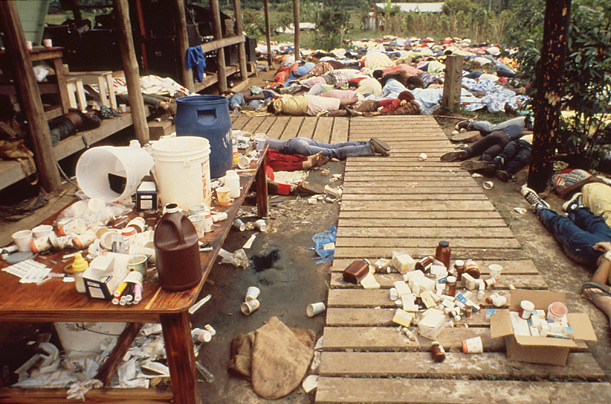
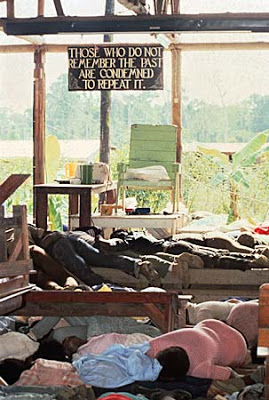
Dozens of audio recordings of Jim Jones's mandatory ideological lectures exhorting the virtues of North Korea and heaping praise on Kim Il Sung, and North Korean provided ideolgical propaganda material were recovered at Jonestown by U.S. government investigators who combed the 1200 acre commune for evidence while others recovered and transported the bodies of the hundreds dead. In addition thousands of documents were recovered, including the notes to Jim Jones with detailed minutes recorded of the contents of the clandestine meetings with North Korean embassy officials held by top lieutenants of Jones charged with carrying out his directives and interacting with various Socialist embassies, the U.S. embassy, and numerous high level officials, many sympathizers of both Jonestown and the Pyongyang government.
There were numerous parallels between the People's Temple and the DPRK- and, equally between Jim Jones' and Kim Il Sung-and their remarkably similar uses of organization of internal control, ideology, religious based tactics to strengthen political strategy and the reverence and perceived infallibility of single leader who served as, and was viewed as, a version of both a God King and a father figure to their follower.
Mandatory hard manual labor and ideological study sessions, emphasized through loudspeakers that were placed throughout the work sites and living areas, often broadcast 24 hours throughout the day and night were shared features at Jonestown and throughout the DPRK. Required mass meetings presided over by Jones focused on criticism and self-criticism, and emphasized the rights of a collective above private property rights or the individual.
In the 1970's, these political tactics which were central to Jones' vision of achieving a Socialist utopia, and no other nation on earth exemplified-or was as strident in the use of these means of social organization—more than the Democratic People's Republic of Korea and Kim IL Sung.
Equally no nation in the world shared Jonestown and the People's Temple central tenet of promoting themselves as a new and unprecedented higher form of social and political organization that portrayed its citizens as an extended family with a single, revered leader with supernatural abilities at the helm than North Korea.
"What you need to believe in is what you can see … If you see me as your friend, I'll be your friend. As you see me as your father, I'll be your father, for those of you that don't have a father … If you see me as your savior; I'll be your savior. If you see me as your God, I'll be your God," Jones lectured his followers during one sermon.
In 1977 Marceline Jones told the New York Times that, at age 18 when Jones watched his idol Mao Zedong overthrow the Chinese government, he realized that the way for Marxist revolution in the United States was to mobilize people through religion. "Jim used religion to try to get some people out of the opiate of religion. He slammed the Bible on the table yelling "I've got to destroy this paper idol!" said his wife.
"You're gonna help yourself, or you'll get no help! There's only one hope of glory; that's within you! Nobody's gonna come out of the sky! There's no heaven up there! We'll have to make heaven down here!" Jones preached to his followers.
Kim Il Sung, the founder of the North Korean state, was the son of pre-revolutionary Korean Presbyterian preachers and played the organ in his father's church, where he heavily learned the religious based usefulness of religious tactics to obtain followers and as a means of mass indoctrination.
By 1978, Jones conducted mandatory ideological training classes in their jungle encampment led by North Korean diplomats based at the embassy in Guyana of Kim IL Sung thought, read from North Korean provided propaganda tracts, and screened North Korean propaganda films at mandatory political study meetings.
In an April 2, 1978 document from Jones's top aide to Jones detailed the minutes of another meeting between North Korean intelligence operatives seconded to their embassy in Guyana and Jones's wife, Korean children and People's Temple officials:
"They seemed deeply moved that Jim and Marcie had adopted Korean children and gave them and opportunity to grow up healthy and socialistic. Tthey say we are progressive and humanitarian and they are very interested in further contact with us (their ambassador appears to be very willing to greet with us and is (or appears to be) a kindly friendly man. I am not to sure of these people as I am not too familiar with the Korean culture and they are overly polite in their speech and yet frankly inquisitive of us, even asked (Jones's wife) Marcie how old she was and how old JJ was. I think they are cultivating us for some purpose (perhaps to send letters to the US for some purpose and to ask for support from US officials for reunification of Korea (not that this would be something that would be bad for them to cultivate us for, but it seems they are quite eager for us to be in contact with them."
In 1977, Jones lost a bitter legal battle over custody of his illegitimate 5 year old son, whom he had fathered with the wife of a married couple who were then members of the People's Temple, defected from the group and instituted a high profile legal and public relations battle in the U.S. accusing Jones of forcing people to remain in Jonestown against their will-including their 5 year old son. They had won custody in a U.S. court (under California law, a married couple held legal right to custody of a child, despite the true paternity.)
Jones and top lieutenants were convinced this was a centerpiece of an American intelligence campaign to destroy his attempts to build a socialist utopia led by American citizens in the Guyanese jungles.
In September 1977, a Guyana court agreed with the U.S. court. Jones, already mentally unstable, seriously ill with a life threatening disease, addicted to mind altering stimulates, and convinced he was God incarnate, felt under siege and no longer felt he had the unwavering political support and protection of Guyana's government. He began to fully focus on suppressing dissent among his ranks and ordering top lieutenant loyalists to formally explore efforts for a mass exodus from Guyana to a third country.
Like North Korea, Jim Jones's followers in the jungles of Guyana, once they arrived, had absolutely no means of communication with the outside world. Even if they gathered within themselves the courage and resolve to leave, escape was nearly impossible. They would have had to sneak out of the camp where they were constantly being surveyed, find a way through the 250 miles of jungle that separated them from the Guyanese capital at Georgetown, where there was a US Embassy. The only communication with the outside world was controlled Jones. Like those in North Korea, their minds and bodies were completely isolated. They lost their personal identities lived lives based on fear.
Those who opposed Jones were punished and often tortured. Infractions included defying Jones, non-attendance at mandatory meetings, not reporting infractions of other members, not working hard enough, or expressing desire or attempts to leave. In order to survive, one had to keep their thoughts completely to themselves; become silent; become unquestioning; become obedient. These traits, the traits that the members had become violently conditioned to follow, are what cost 908 people their lives on November 18, 1978.
Jones first conceived of Jonestown in 1970 to create a "socialist paradise" and established the "People's Temple Agricultural Project". Jones, like KIm Il Sung, said of his model communist vision: "I believe we're the purest communists there are."
The parallels between North Korea and Jonestown are stark.
Here are some excerpts from my upcoming investigative report based on hundreds of hours of tape recording and documents recovered from the People's Temple massacre site, interviews with surviving members of the People's Temple, and other research conducted over the last 18 months.
"We were speaking to the first secretary when the Korean Ambassador entered to speak to us. He said they have been trying to locate us, they will have many things to do with us. He was glad to see us there as they were searching for our location. The First Secretary later told us they had heard of us in North Korea, their information service provided the information. He asked a lot of questions; basically he wanted to know the nationalities of our members, the names of the people who coordinate here and in the United States. E.g.…..Leaders proper names, how many Koreans, blacks, whites, Chinese, American Indians? Leaders children's names here and in the U.S., asked several times about Lew, said they would like to see him if he comes into town. He asked for directions to our home offices in Georgetown, said he would like to come. Sharon asked what they found interesting about us? He said they liked our involvement in humanitarian projects, and after reading and making the contact with us, it will make them more knowledgeable as to how we can cooperate and work together with them. He said they were interested in all progressive people. Sharon asked if he found it strange that a group of Americans were in Guyana living cooperatively? He agreed that they did. The Ambassador sent messages to us that he regretted he was not able to spend more time with us today, but he would see us another day. They gave us quite a bit of literature on Korea, and books written by their leader, comrade Kim Il Sung."**—**March 17, 1978, Jim Jones People's Temple Notes from a Meeting at the North Korean embassy, Guyana:
"MTG AT KOREAN EMBASSY: Comrade Lee, Comrade Joe, Visited by, Marceline Jones (Jim JOnes's wife), Ava Jones, Lew Jones (Jones's children), Deb, Kim Yoon Ai, Sharon Amos……."Comrade Lee said he enjoyed very much our wonderful performance, and enjoyed our introduction about our agricultural project. Marceline said: "We feel very close to the Korean people". She told him she had adopted three children from Korea. Cde. Lee asked Lew if he spoke the Korean language. (served soft drinks and plenty of refreshments) Cde. Lee said he was told before there was an agricultural project from people who came from the States…said Sharon had explained and he had a better understanding. Marceline gave him some background on Lew and Kim….Marceline gave a few details, including 900 acres planted and 1200 acres cleared….He said "In a certain sense you are an independent autonomous Kingdom." Cde. Lee mentioned that…..there are some maneuvers to do harm to our movement….he was obliged to express his thanks to Jim Jones for his efforts…They brought out a drink that they wanted us to take, made in Korea. Sharon told him of our commitment to our youth and that we don't drink. It was called Insam, made from Ginseng tea, it had the actual root at the bottom of the bottle….Lee said he understood People's Temple was striving for Socialism, that some people use it for propaganda, so they like to describe their form of Socialism. He said Socialism to them is a world where the welfare of the people is highly shared. Our country is not so big; almost the same size as Guyana, but the population is larger. He told us of the History…."—April 2, 1978 meeting at North Korean embassy Guyana
"MTG WITH COMRADE JO: He asked if we were religious. I said we were not, but like in his country we have a few, a very few who are still coming out of the religious realm, just a few older people, but that you were bringing them out of that I told him that we had started out as a church because it was the only way to reach the people, most of the poor and the oppressed were in the church and that the church was what kept people from protesting their surroundings, so you have slowly been educating us to Socialism e.g. by showing the different errors in the bible and how it says slaves obey your masters, so people didn't fight against slavery, he agreed, he said he wanted to know how you had educated the people.
I told him that we didn't have church in Guyana but that we held classes on socialism and the classes are held at different levels, sometimes depending on the level of understanding of the people
They said before we left we should come by more often and that Terri should not have waited so long to come in and see them. Comrade Jo said they were always glad to see us because they wanted to stay in touch with us.
They said they wanted a photo of Jim Jones and his wife, also Kim Yooni and family, they also wanted two copies of the peoples Forum every month"—-May 1978 meeting with Jim Jones family and top lieutenants held at North Korean embassy, Guyana
"I had mentioned the possibility of our people moving to the DPRK as …..We had just been concerned about what would happen to the children and the old people if the US put too much pressure on Guyana." North Korean First Secretary "Comrade Li asked about us giving up US citizenship…."**—-**August 10, 1978 Sharon Amos, Jim Jones top lieutenant and founder of the Guyana-Korea Friendship Society, in minutes sent to Jim Jones after meeting North Korean embassy officials in Guyana where they had inquired about seeking mass political asylum.
"Much care and much love to you, comrades. I love you with so much deep, deep love. Us– bring us–us to back to the discipline. I've been reviewing, I've been up all night, and today I've been reviewing some new films that we have from North Korea that shows people working voluntarily sixteen hours a day…..how happy and joyous they are and disciplined and how beautiful their country is. Building, organizing, has structure. Eight hours for rest, eight hours for study, eight hours for work, no less. And that is reality. You'll be seeing the film. It's not that long– it won't be long before you'll be seeing this beautiful Technicolor film of the People's Democratic Republic of North Korea under the great leadership of the communist Kim Il-sung (who) led the brave and victorious battle that won the victory at least for a segment of Korea. Unfortunately, USA, in its imperialist design that makes our hearts feel heavy with guilt because we paid our tax dollars, has cut off half of Korea and is living under a concentration camp-type apartheid dictatorship. But North Korea flowers in democracy with free health, free medical care that is, free meals, collectivism….. Much love, I love you very, very deeply indeed.
All of North Korea was flattened by bombs from USA. There wasn't a building left intact. Now everything's restored. Free medicine, free medical care. And they exalt their leader as a- as a savior, as a god. Kim Il-sung. But that's necessary, because people who have been conditioned to worship for many, many, many, many generations and centuries, but they- he uses that power, not to corrupt, but to give power to the people. There're no political prisoners, by the way, in- and freedom of religion still exists in North Korea."—October 21 1978, Jim Jones, in a mandatory mass meeting in the Jonestown Guyana People's Temple where 913 People died from murder and mass suicide days later
"The North Koreans have built a socialist society, a socialist society with one of the highest standards of living in the world, in and of itself. Their success then have not been based on magic or good luck or favorable weather conditions, because cloud seeding has been uh, used against them by our tax dollars through the CIA. The DPRK, communist North Korea, attributes its advances to a strong political line summed up in the Korean word, "Juche," j-u-c-h-e. The word does not have an equivalent in English. Roughly it can be translated as self-reliance. As developed by President Kim Il-sung, Juche, the concept stands on three legislative, political independence, economic self-reliance, and military self-defense. Basing itself on [three pronunciations] the Juche, or the Juche, or jussie, j-u-c-h-e concept - someone else can give you a proper pronunciation - the DPRK industrialized its agricultural country in only eight years. Now this is the picture we saw the night before last. The beauty of their organization, where they work sixteen hours. Eight hours of work. Eight hours of study. And then eight hours of rest. And it was this industrialization that laid the groundwork for establishing an independent economy which, as the Koreans realized from their colonial experience, was their only way to truly safeguard their political sovereignty. There is such unity and solidarity in this country that they do not have one jail in the country inhabited by over fifteen million people. Perhaps more important, remembering that US troops are still poised on North Korea's southern borders, ready to invade at any moment, this industrialization created the basis for the DPRK's own defense capability. The Korean people have been the main beneficiaries of these significant accomplishments. Health care and education are free, with a universal eleven-year compulsory education system for everyone. Comprehensive daycare centers have been established for working women. Recreational centers have been provided throughout the country of the most modern variety like our carnivals and circuses. There are state subsidies on basic foodsubs- foodstuffs, particularly rice. Free clothing is given to schoolchildren and workers. Subsidies mean that the rice cost little or nothing. Large-scale construction of new housing has guaranteed livable housing all for now no rent at all. Now that's what work brings about. We can free so many people, and if we work now, we can get to a place that doesn't work that hard, but we must work and our observers- I'm instructing the security to see that the job is done and that every name is put down. Equality and prosperity- and the supervisors will be held responsible, by the way, for any of your workers that are not doing what they should be doing.
The hands of US imperialism and its lackeys reach directly into the lives of all Koreans. We here in Guyana have the opportunity and the duty to help remove it by- for work and produce, we can send out funds to help other systems. We also already have helped the DPRK while we've been here, but we've got to do more. We've got to get our people to freedom. I would think you'd take joy in just working to make funds for Democratic People's Republic of North Korea. I would think that would turn you on. But some it doesn't. So observers will. Yes, because of the threat of revolution, the United States knows it's necessary to maintain its huge fascist army in the south. The hands of imperialism reaches directly into the lives of all Koreans. We here have the opportunity and, I - as I've said before - the duty to help remove it. Who in the world is better situated to take up this fight than we, the only socialist movement, as the different guests have said in the last few days, in the United States? If we don't take it up, who will? We must always work. We know the night's coming when no man can work. We know nuclear war looks inevitable. We know it looks like almost an absolute.…..digest what you have for testing tonight in People's Rally. Thank you for your consideration and time, and I do love you more as I say than you'll ever know. Good morning. Good evening. Good day."—Jim Jones, November 1, 1978 mass meeting speech in Jonestown, Guyana
Jim Jones: "WPK general staff of the Korean Revolution. The Workers Party of Korea, the DEPK– RK, that beautiful, practical, lovely co– country that we saw on our TV station, where all the children eat rice as a staple food, and how healthy they look, and how vigorously happy, enthusiasm on all their faces,
Voices in crowd: That's right.
Jones: You certainly better be prepared, not sittin' on our bony– People say, there's too many meetings. I'm rather tired of hearing about too many meetings, in that we've got uh, Democratic Peoples Republic– which I could've shown you tonight but I'll probably show you tomorrow in the language session. And all will be required to attend. Say, "I don't like these meetings." Neither do I. But we've got to get ourselves in readiness now to meet certain elementary requirements. In the Democratic People's Republic of North Korea, people work automatically 16 hours a day. And you will see their faces shining and beaming and healthy. I know that some of you gruntle [grumble] and– disgruntle and cry over that…That means we got to make this a model. Everything's got to be up to par. It's going to take more work than we're now doing. You understand?
Voices in crowd: (Scattered) That's right.
Jones: Because they want a model of pure communism. Do you understand what I'm saying?
Crowd: Right.
Jones: They said we are the purest communist model that exists. No monetary system. It does not exist any place in the world. We don't use money between us. They want that to continue. But they also want productivity to continue, good health and hygiene, good education. So that means a constant input of correction."—-Jim Jones speaking to a mandatory meeting at the Jonestown People's Temple, November 1, 1978, 16 days before all 903 people died in a mass murder and enforced suicide. ■
2 Reader Comments
Lawrence says
(2017-07-24T13:46:40-05:00)
Will you ever be publishing your extensive investigative report?
Nate Thayer says
(2017-07-27T17:59:30-05:00)
Which one are you referring to?